
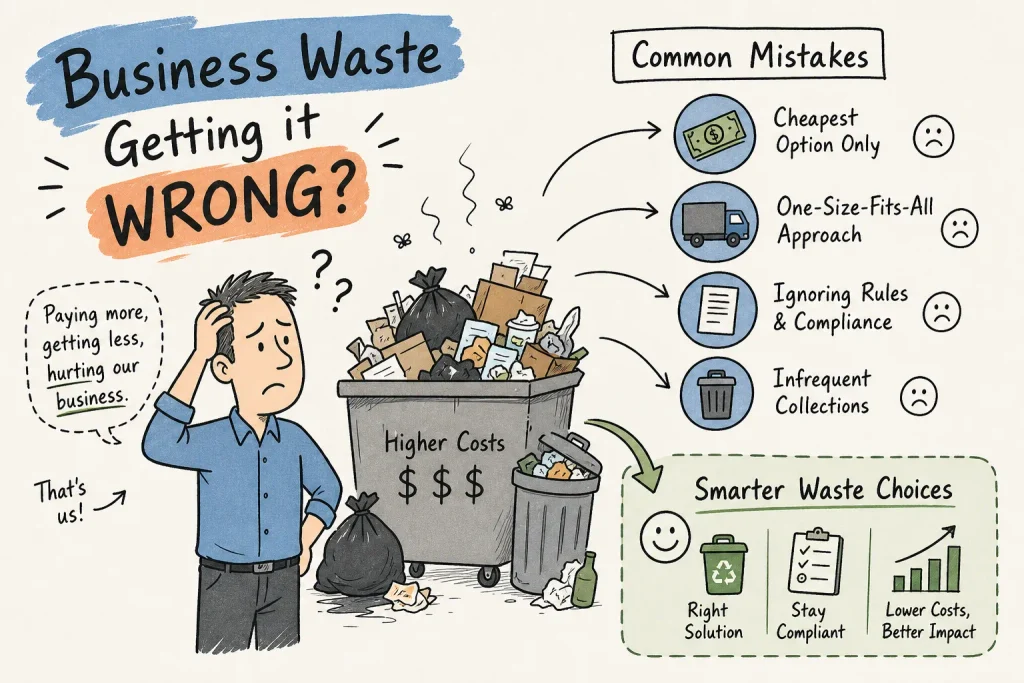
When evaluating business waste disposal options, most companies simply keep whatever system was put in place on day one. Nobody made a deliberate decision. Someone called a number, a bin showed up, and that was that. Years later, the bin is still there, the invoices keep coming, and nobody has stopped to ask whether this is still the right arrangement.
That default is often costing money, in ways that don’t show up as a single line item. And in Metro Vancouver, sticking with an inherited setup can also create real compliance risk. This article covers the four main business waste disposal options available to Canadian companies: landfill disposal, self-haul drop-off, municipal commercial pickup, and private recycling services. Understanding what each one actually includes, and what it doesn’t, is the only way to make a deliberate choice instead of inheriting someone else’s.
For Lower Mainland businesses especially, the regulatory environment adds pressure that most Canadian cities don’t face in quite the same way. Metro Vancouver’s Organics Disposal Ban creates a compliance layer that changes the calculus entirely. Getting this wrong isn’t just inconvenient. It’s a surcharge on your next waste load.
Before comparing costs and compliance, it helps to know exactly what’s on the table. These four commercial waste management models cover the full range of what’s realistically available to most commercial operations in Canada.
This is the simplest model. Everything goes in one bin, a hauler picks it up on a schedule, and it ends up in a landfill. No sorting required, no material separation. The trade-off is cost: landfill-only approaches can become increasingly expensive over time, especially as disposal bans and surcharges increase compliance exposure. You’re paying to avoid complexity now, and you’ll likely pay more for it later.
Your business loads recyclables or waste into a vehicle and drives it to a regional depot or transfer station. There’s no pickup fee, which makes it look cheap. But staff time, fuel, and vehicle wear are real costs that rarely show up in anyone’s calculation before they commit to this model.
Most cities offer some level of commercial service, but what’s included varies significantly. General garbage pickup is common. Organics, e-waste, Styrofoam, and mixed recycling are frequently excluded or available only through separate special programs. Many business owners assume their municipality covers everything. That assumption is where compliance gaps start.
A private provider handles regular pickups for one or more material streams. This can include organics, mixed containers, cardboard, Styrofoam, and e-waste under a single arrangement. This is the model full-service commercial recycling providers like EcoAction Recycling are built around, and for most businesses managing multiple material streams, it tends to be the most practical approach available.
Self-haul looks affordable until you run the actual numbers. The tipping fee is obvious; everything else gets absorbed quietly into operating costs.
At Metro Vancouver transfer stations in 2026, commercial self-haul loads are charged at $182 per tonne for loads under one tonne, $162 per tonne for loads between one and 7.99 tonnes, and $136 per tonne for loads of eight tonnes or more. There’s also a $5 transaction fee per load and a minimum charge of $25 during weekday peak hours. For comparison, organics loads run $155 per tonne and special handling waste hits $310 per tonne. These are not small numbers for a business making regular trips. (Fee schedules are published annually by Metro Vancouver and should be verified against the current transfer station rate table before budgeting.)
Someone has to sort the material, load the vehicle, drive to the facility, wait in line, and drive back. That’s staff time pulled from actual work. Add fuel and vehicle wear, and the math on self-haul changes fast. As an illustrative example, a half-load haul in the Lower Mainland can run roughly $495 plus tax before the tipping fee, and a full load closer to $695 plus tax, depending on the provider and distance. If you’re doing this more than occasionally, you’re not saving money. You’re just moving the cost somewhere less visible.
Self-haul works for low-volume businesses with flexible schedules, or for specific material streams, like Styrofoam or e-waste, that aren’t covered under a regular hauler’s service. It also works well for one-off cleanouts. For anything recurring, the labor and logistics costs stack up quickly.
Municipal services exist for a reason. They’re accessible, they’re established, and for basic general waste, they often work fine. The problem is when businesses treat municipal pickup as a complete compliance solution. It isn’t.
General garbage collection is the core of most municipal commercial programs. Recycling inclusion varies by city and building type. Organics pickup for commercial businesses is frequently excluded or limited to specific sectors. E-waste, Styrofoam, and many industrial materials commonly fall outside standard municipal collection programs, though some are handled through separate special-collection streams or partner programs, it depends on your municipality. If your business generates any of these streams, it’s worth confirming coverage directly with your city before assuming you’re compliant.
The Metro Vancouver Organics Disposal Ban requires businesses to keep food waste out of the landfill-bound garbage stream. It’s not optional, and it’s not enforced lightly. Loads arriving at regional disposal facilities are inspected, and any load containing 25% or more food waste by weight or volume triggers a 50% surcharge on the full tipping fee. That surcharge hits the hauler, who passes it straight back to you. Municipal garbage pickup does not solve this on its own. Restaurants, food service operators, grocery retailers, and multi-tenant buildings are the businesses most exposed to this penalty.
Regulatory responsibility doesn’t stop where municipal service ends. A business relying solely on city pickup for compliance is often not actually compliant. A secondary private service fills that gap, and for most Metro Vancouver businesses producing food waste, that secondary service isn’t optional. It’s a legal requirement with a financial penalty attached.
Private haulers handle the bulk of commercial waste in Canada. For many businesses, a front-load dumpster from a national hauler is the default. That default comes with contract terms worth reading carefully before you sign.
Recurring front-load commercial service in the Lower Mainland typically runs between $100 and $600 per month for small businesses and $225 to $1,200 or more per month for mid-size operations, depending on container size, pickup frequency, and waste type. Commercial dumpster rental for one-off needs, roll-off containers, runs from roughly $349 for a 10-yard bin to $749 or more for a 40-yard container on a seven-day rental. These base rates generally don’t include fuel surcharges, environmental fees, or overage charges, which can add meaningfully to the final invoice. Verify what’s included before comparing quotes.
The major commercial waste haulers in British Columbia, including GFL and Waste Connections, typically structure business contracts with three to five year terms and automatic renewal clauses. CPI-based price escalators, fuel surcharges, and environmental fees are standard. Early termination provisions exist, but the exit costs are usually significant. Contamination penalties for recycling and organics streams can result in load rejection, reclassification to general waste, or extra fees on top of the regular invoice. These aren’t hidden exactly, but they are buried in language most people don’t read until they’re already locked in.
Large commercial haulers handle general garbage reliably. Multi-stream diversion, covering organics, Styrofoam, and e-waste, is inconsistent. These streams are often separately contracted, sometimes with different vendors, different billing cycles, and different reporting. For businesses trying to meet Metro Vancouver’s diversion requirements under one coherent program, this creates a vendor management problem that shows up in missed pickups, billing disputes, and no single point of accountability.
The alternative to juggling multiple vendors and navigating multi-year contracts is a single provider that handles every material stream your business generates. That’s the model EcoAction Recycling is built around.
EcoAction Recycling’s service is structured to cover organics and food waste, mixed containers, paper and cardboard, Styrofoam (EPS), and electronics under one scheduled pickup arrangement. No separate waste hauler for organics, no scrambling for e-waste disposal, no calling three vendors when something changes. Bins are maintained and sanitized as part of the service, which matters for food-adjacent businesses where bin hygiene is a real operational concern. Confirm the full scope of materials covered when you get a quote, as service offerings can vary by location and volume.
EcoAction Recycling operates on a month-to-month basis with no multi-year commitment required, a meaningful structural difference from the long-term contracts standard with most large haulers. The pricing model is designed to be transparent, without the fuel surcharges and environmental fees that tend to inflate invoices elsewhere. Businesses across Vancouver, Burnaby, Surrey, Coquitlam, and the surrounding Lower Mainland can start service without the early termination exposure that comes with a typical large hauler contract. As with any provider, confirm pricing terms and what’s included in writing before starting service.
EcoAction Recycling provides monthly waste diversion reports tracking what materials were diverted from landfill and in what volumes. For Metro Vancouver Organics Ban compliance, that documentation matters. For businesses with internal sustainability reporting or ESG commitments, it provides specific data that many local providers don’t offer. Ask any provider you’re evaluating whether they supply diversion documentation, and what format it comes in.
The right disposal model isn’t the cheapest one upfront. It’s the one that keeps you compliant, handles your actual material mix, and doesn’t lock you into terms you’ll regret. Here’s how to think through it systematically.
If your business generates low volumes and a single material stream, self-haul or basic municipal service may be sufficient. If you’re producing organics, mixed containers, cardboard, and other streams on a regular basis, a private multi-stream provider is almost always more practical and more compliant. The volume threshold where scheduled commercial pickup becomes more economical than repeated self-haul trips is often lower than it appears, factor in staff time and fuel before assuming self-haul is cheaper.
If your business produces food waste in Metro Vancouver, you need an organics solution. Full stop. Start with what’s legally required, then optimize for cost and convenience from there. Choosing a cheaper option that leaves you out of compliance isn’t a savings. It’s a deferred surcharge.
These questions surface the details that matter most, and the answers will tell you a lot about whether a provider is straightforward to work with or not.
Most businesses treat commercial waste disposal as a background function. Set it up once, pay the bill, move on. That approach works until it doesn’t, and in Metro Vancouver, it’s increasingly not working. The Organics Ban has teeth. Contract lock-in with large haulers is real. And the cost of self-haul at scale is rarely what it appears on paper.
The right model depends on your volume, your material mix, your compliance obligations, and whether you want flexibility or are comfortable with a long-term commitment. For most Lower Mainland businesses producing multiple waste streams, a full-service provider handling everything under one arrangement, with no long-term contract and clear monthly reporting, is the most sensible approach.
Review your business waste disposal options now, before your next invoice arrives. If you want to understand what a full-service commercial recycling arrangement would look like for your operation, get in touch with the team at EcoAction Recycling. No contract required to get started, and the conversation costs nothing.