
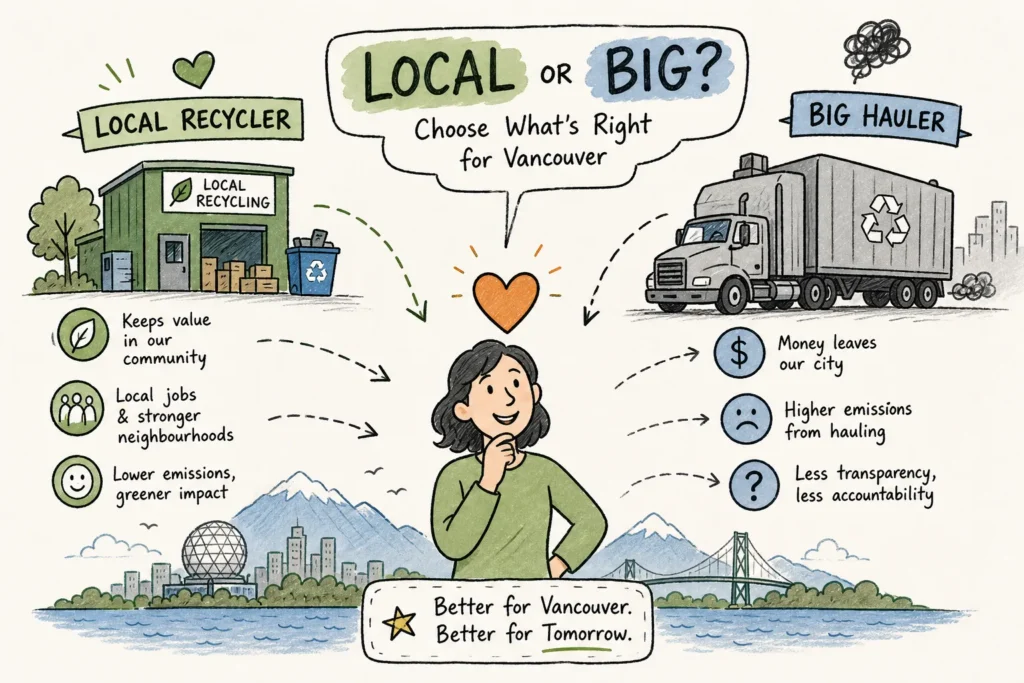
If you’re a Vancouver business owner asking whether you should use a local recycling company or a large hauler in Vancouver, the answer depends on a few specifics, but the pattern we see in practice leans strongly in one direction. In our experience working with businesses across Metro Vancouver, the typical approach is to call a large hauler first because the name is familiar, sign whatever contract is offered, and spend the next few years wondering why the recycling situation feels more complicated than it should. The choice between a local recycling company and a large national hauler looks simple on paper. The real-world difference is not.
At EcoAction Recycling, we frequently speak with businesses across Metro Vancouver about this decision, restaurants, property managers, office tenants, retailers. The pattern repeats itself. So rather than give you a vague pros-and-cons list, here’s a practical breakdown of what actually separates these two options and how to make the right call for your business.
The structural difference isn’t just size. It’s accountability. Large national haulers are often route-driven corporate entities with regional managers, centralized billing departments, and customer service teams working from ticket queues. When something goes wrong, you’re not calling the operation. You’re calling a representative who logs a complaint and escalates it through a process.
A missed pickup with a large hauler can mean days of back-and-forth before anything is resolved, that’s not a knock on the people working there; it’s simply how large organizations function. With a local provider, the person answering your call is often the person managing operations. The decision-making is right there, which means one conversation can resolve what might otherwise require several interactions spread across days.
Large haulers often build their routes for truck efficiency, not customer convenience. Smaller commercial accounts may get the least flexible scheduling because high-volume clients typically take priority. Local providers tend to build schedules around the businesses they serve, which means your pickup frequency and timing can actually reflect your operational needs. That difference shows up every week.
This is where the comparison gets uncomfortable for large haulers. The base rate they quote you is rarely the number you’ll see on your invoice after the first billing cycle. Fuel surcharges, environmental levies, and regulatory cost recovery fees are common line items. One major hauler’s billing structure, for example, has historically included environmental charges around 20% of invoice charges, with additional regulatory cost recovery fees on top. These line items are worth scrutinizing before you sign.
Public procurement records show that major haulers operating in the Metro Vancouver region, including GFL Environmental and Emterra, have structured contracts with five-year base terms and multi-year extension options. For a small or mid-sized business, that’s a significant commitment with compounding annual rate escalations built in. Cancellation windows in commercial hauling contracts can run as long as 90 days, so review the exit terms carefully before committing.
Month-to-month service creates a different dynamic. When a provider has to earn your business every month, their operational incentives are different than when you’re locked in for five years. Transparent, itemized pricing means no surprises on the invoice, and itemized pricing isn’t just a convenience; it’s structural pressure on the provider to actually perform.
This section matters most for businesses operating under Metro Vancouver’s Organics Disposal Ban. The ban applies to all businesses in the region that generate food scraps and compostable organics. Non-compliance doesn’t result in a fine delivered directly to your door. It results in surcharges levied against your hauler when banned material is found in garbage loads, and those costs get passed back to you. Food waste above 25% of a load triggers a 50% surcharge on the tipping fee. Expanded polystyrene above 20% of a load triggers a 100% surcharge. These thresholds are documented in Metro Vancouver’s organics ban guidance for businesses.
General waste and cardboard are the standard offering from many large haulers. In many cases, organics, Styrofoam (EPS), e-waste, and mixed containers are excluded from base contracts, subcontracted to a third party, or require separate agreements with separate pricing. A business trying to comply with Metro Vancouver’s full diversion requirements may end up managing two or three vendor relationships just to cover the material streams they legally need to address.
EcoAction Recycling handles organics and food waste, mixed containers, paper and cardboard, Styrofoam, and electronics recycling under one account. For Metro Vancouver businesses, that means Organics Ban compliance, mixed container diversion, and specialty materials like e-waste are all managed through one provider, one invoice, and one point of contact. Beyond the operational simplification, EcoAction provides monthly waste diversion reports that give businesses actual data on how much material is being kept out of landfill. Not all local providers offer this level of account-specific reporting.
A business using a hauler that doesn’t offer an organics program is not in compliance with the Metro Vancouver Organics Disposal Ban, regardless of what else they’re recycling. That’s a risk-management issue, not a preference issue. Metro Vancouver’s regional reporting has placed the commercial recycling rate at around 48%, a figure from the Metro Vancouver Biennial Solid Waste Report. A provider who covers all your material streams, and documents the diversion, puts you in a materially better position than one who handles only part of the picture.
Response time matters in practice. A missed organics pickup at a restaurant on a Thursday night before a long weekend is not an abstract inconvenience, it’s a real operational problem that needs a fast resolution. In our experience, a call to a large hauler typically goes to a centralized service team that logs a ticket and targets resolution within a defined service window. A call to a local provider is more likely to reach someone who can dispatch a solution the same day. We present that as an operational observation, not a guarantee, because every provider is different.
Local providers tend to know your building, your schedule, and your specific waste profile. That context matters when something needs to be adjusted quickly or when your volume changes seasonally. Large haulers operate at scale, which means your account is one of thousands. The local model means your account is known by name.
Monthly waste diversion reports give you real metrics: how many tonnes diverted, what materials, what percentage kept out of landfill. For businesses with ESG commitments, tenant transparency obligations, or strata reporting requirements, this data is increasingly necessary. Large haulers rarely provide this at the individual commercial account level. When they do, it’s often a high-level aggregate, not a breakdown tied to your specific account.
Before you sign anything, confirm the hauler is operating legally in the region. Metro Vancouver maintains a public list of licensed solid waste and recyclable material handlers. The City of Vancouver also publishes a hauler registry for companies servicing multi-unit buildings. These lists include companies such as GFL, Waste Management of Canada, Emterra, Urban Impact, Recycling Alternative, and others. A quick check of these publicly available documents confirms whether a provider meets minimum regulatory requirements to operate in Metro Vancouver, think of that as the floor, not the ceiling.
Use Metro Vancouver’s licensed solid waste and recyclable material list as your first verification step. The City of Vancouver’s hauler registry is the right starting point for businesses within city limits. Both are publicly available. Licensed status confirms a company meets minimum regulatory standards, but it says nothing about diversion rates, contract practices, or responsiveness.
A licence confirms a hauler can legally operate. That’s it. The practical verification steps matter more. Ask for references from similar businesses in Metro Vancouver. Request a sample invoice before you commit. Get the full contract terms in writing before service begins, and read the auto-renewal clause and cancellation window carefully. Those steps tell you far more than a licensing check alone.
Before choosing between a local recycling company and a large hauler in Vancouver, four questions should drive the evaluation. First: does this hauler cover all the material streams your business needs, including organics and any specialty materials? Second: what are the exact contract terms, including length, auto-renewal conditions, and early termination penalties? Third: can they provide references from similar businesses operating in Metro Vancouver? Fourth: will you receive regular diversion reporting, and in what format?
A provider who can’t answer all four questions clearly is telling you something. A provider who answers all four with specifics, in writing, is giving you what you need to make an informed decision. Watch out for vague commitments on contract terms and material coverage in particular. A specific answer looks like: “We provide a monthly PDF diversion report per account showing tonnes diverted by material stream.” A vague answer looks like: “We track diversion across our routes.” Those are not the same thing.
Large haulers can be a reasonable fit for very high-volume, single-stream waste situations with predictable schedules and the leverage that comes with large contracts. For Metro Vancouver businesses dealing with mixed materials, Organics Ban compliance, and a need for scheduling flexibility, that profile typically doesn’t apply. In our view, those businesses are generally better served by a local provider offering no-contract service, multi-stream capability, and direct accountability, though we’d encourage any business to evaluate that honestly against their own situation.
Bigger doesn’t mean better in commercial recycling. When businesses ask whether they should use a local recycling company or a large hauler in Vancouver, the answer almost always comes back to the same factors: what materials need to be handled, how much contract risk is acceptable, and whether the provider is actually reachable when something goes wrong. For the majority of Metro Vancouver businesses, those factors point toward a local provider.
If you want a local recycling company in Vancouver with no-contract flexibility, full-stream coverage including organics and e-waste, and monthly diversion reporting, call our team at EcoAction Recycling or fill out the form. We’ll tell you exactly what your business needs and what it costs.