
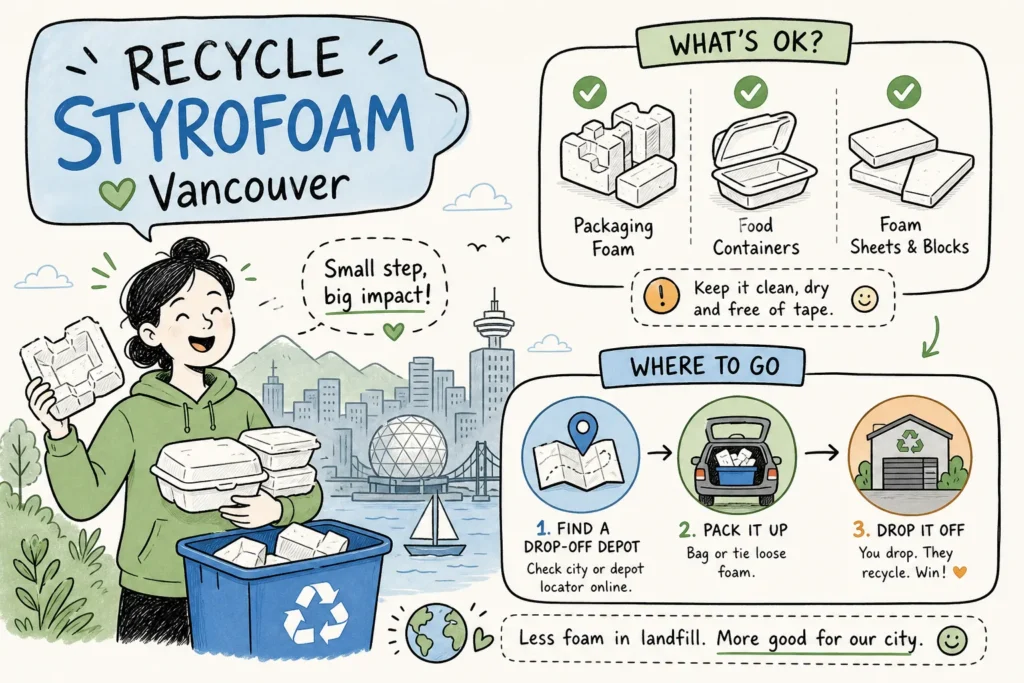
Picture this: you’ve just unboxed a new appliance and you’re standing in your kitchen holding a dense white block of foam padding. The blue bin is right there. But something stops you. You’ve heard foam is different. You’re right, it is. Styrofoam, or more precisely expanded polystyrene (EPS) foam, doesn’t belong in your blue bin, and tossing it there doesn’t help anyone. It gets pulled out as contamination and ends up in the landfill anyway. If you’re looking for styrofoam recycling Vancouver options, the good news is that a real system exists, it just doesn’t run through your curbside cart.
Foam recycling in Metro Vancouver is genuinely possible. The system runs on a separate track from curbside collection, and knowing the rules upfront saves you a wasted trip. For residents dealing with the occasional appliance box or grocery tray, a depot drop-off works well. For businesses receiving foam-packaged goods on a regular basis, the volume adds up fast enough that scheduled commercial pickup becomes the smarter call. This article covers both paths: which foam types qualify, where to take them, how to prep your materials, and what happens after collection.
Recycle BC explicitly classifies foam packaging as a “depot-only” material. That means it’s excluded from curbside collection and multi-family blue bin programs across Vancouver, full stop. This isn’t a gap in the system; it’s a deliberate policy decision based on how EPS foam behaves during collection. It’s extremely light, breaks apart into small beads easily, and contaminates other recyclables when it ends up loose inside a curbside cart. Even if your building has a well-managed blue bin setup, foam packaging still doesn’t belong there.
EPS foam has a very low density, which means it takes up enormous volume relative to its weight. That’s already a problem for transport, but the bigger issue is what happens at Materials Recovery Facilities. Automated sorting equipment rejects foam, and the beads it fragments into clog machinery and contaminate other material streams like paper and glass. Depot collection solves this by handling foam separately, in bulk, before it ever touches the mixed recycling stream.
The foam types accepted at Recycle BC depots and the Vancouver Zero Waste Centre include meat and produce trays, foam egg cartons, takeout clamshells, cups and bowls made from foam, and firm cushion packaging used to protect electronics and small appliances. Minor attached materials like labels, tape, or small bits of cardboard are generally acceptable at most depots. The key visual identifier is simple: white or off-white rigid EPS. If it’s white, firm, and breaks with a snap rather than bending, it’s likely in the right category.
Before you pack up your load, run through this checklist. Packing peanuts and loose foam chips are not accepted. Many peanuts are actually made from cornstarch rather than EPS, and even the ones that aren’t cause sorting problems at the depot. Blue or pink foam board insulation, flexible or squishy foam, foam furniture cushions, and pool noodles are all rejected outright. Contaminated, painted, or wet foam gets turned away at the door. Asking yourself four quick questions before you head out, is it white? rigid? clean? dry?, takes three seconds and saves a wasted trip.
The main city-run option for Vancouver residents is the Vancouver Zero Waste Centre at 8588 Yukon St. It’s open Monday to Saturday from 8:00 AM to 6:00 PM, Sunday from 9:00 AM to 6:00 PM, and on holidays from 9:00 AM to 4:00 PM. It’s a reliable first stop for anyone clearing out seasonal packaging or post-renovation foam waste. Hours are subject to change, so confirm current times before you go.
Several other locations across the city also accept foam packaging. The South Van Bottle Depot at 34 East 69th Avenue is open seven days a week from 8:30 AM to 5:30 PM. The Vancouver Central Return-It Depot at 2639 Kingsway and the Powell Street Return-It Depot at 1856 Powell Street are both part of the Return-It network. London Drugs locations across Vancouver also accept foam packaging, though it’s worth confirming accepted items with your specific store before you go. Recycle BC’s online depot finder is the most reliable tool for checking current hours at any of these locations.
Residents outside Vancouver proper have options too. The Richmond Recycling Depot lists white expanded polystyrene packaging among its accepted materials. London Drugs locations across Burnaby, Coquitlam, Surrey, Richmond, North Vancouver, and other Lower Mainland communities participate in the foam drop-off program through Recycle BC. One practical note: when dropping foam at London Drugs, Recycle BC recommends bringing no more than one grocery bag’s worth per visit due to space limitations at in-store collection points. For anyone with more than that, a dedicated depot is the better fit.
Drop-off foam must arrive clean, dry, and white. Remove all food residue before leaving home; depots don’t have cleaning facilities and contaminated foam gets rejected immediately. Pull off tape, stickers, labels, and any plastic film. If the original packaging came with cardboard attached, separate them before you go. Wet or dirty foam doesn’t just get rejected; it can compromise the entire collection batch, which defeats the purpose of making the trip in the first place.
The most common rejection triggers are moisture, dark discoloration (a sign that the foam isn’t standard EPS), packing peanuts mixed in with rigid foam pieces, and non-foam materials still attached. Run through the white, rigid, clean, dry check before you leave the house. If it passes all four, you’re in good shape. A rejected load wastes your time and doesn’t move the material any closer to recycling, so getting the prep right is worth the extra two minutes at home.
After collection, EPS foam goes through a process called densification. Machines compress or heat the foam to reduce its volume dramatically, often to 1/50th or even 1/90th of its original size. This creates dense blocks or logs that are cost-effective to transport to processing facilities. Without densification, moving foam long distances would cost more than the recovered material is worth. That cost imbalance is exactly why foam so often ended up in the landfill before dedicated depot programs existed.
Densified EPS is processed into raw polystyrene resin, which manufacturers use to make picture frames, crown molding, park benches, hangers, rulers, and new foam packaging components. Some streams feed into thermal insulation products. The recycling loop for EPS is real and functional: the material doesn’t lose quality when reprocessed. But it only works when the input foam arrives clean, sorted, and free of contamination. The care you put into prep at home directly affects the quality of what gets made at the other end.
For a resident clearing out one appliance box, a depot trip works fine. For a retailer, office, or distribution business receiving foam-packaged goods every week, the math doesn’t hold. EPS foam stacks fast, takes up significant back-room storage space, and a car trunk isn’t a viable transport option for bulk quantities. Many businesses end up landfilling foam by default, not because they want to, but because the logistics of depot drop-off simply don’t scale to their volume. That’s a costly outcome, especially given that Metro Vancouver tipping-fee surcharges can apply to loads with high EPS content.
For Metro Vancouver businesses dealing with foam packaging on a recurring basis, EcoAction Recycling offers scheduled EPS foam pickup as part of a broader recycling program. Rather than accumulating foam in a back room and organizing staff trips to a depot, your team can focus on core operations while foam gets collected on a reliable schedule. EcoAction services businesses across Vancouver, Burnaby, Surrey, Coquitlam, and surrounding Lower Mainland communities, handling foam alongside organics, mixed containers, cardboard, and e-waste under one provider.
There’s no long-term contract required, and monthly waste diversion reports show exactly how much material is being diverted from the landfill. For a retail shop, office building, or property manager trying to demonstrate environmental accountability, that documentation matters. Reach out to the EcoAction Recycling team directly to discuss pickup frequency and what a commercial foam recycling arrangement would look like for your specific business.
EPS foam recycling in Vancouver is entirely doable, but it runs on a different track than most recyclables. The system works when you know which foam qualifies, prepare it correctly, and use the right drop-off channel, keeping four words in mind covers most of it: white, rigid, clean, and dry.
If you’re a Vancouver resident working through a stack of appliance packaging, the Zero Waste Centre on Yukon Street or a nearby Return-It depot is your best starting point. If you’re a business dealing with foam packaging every week, scheduling a commercial pickup is the smarter move. Foam doesn’t belong in the landfill, and with the right channel in place, it won’t end up there. Pick the path that fits your volume, follow the prep rules, and the material will find its way into something new. That’s exactly what recycling is supposed to do. For commercial volumes, contact EcoAction Recycling to find out what a scheduled pickup program would look like for your operation.