
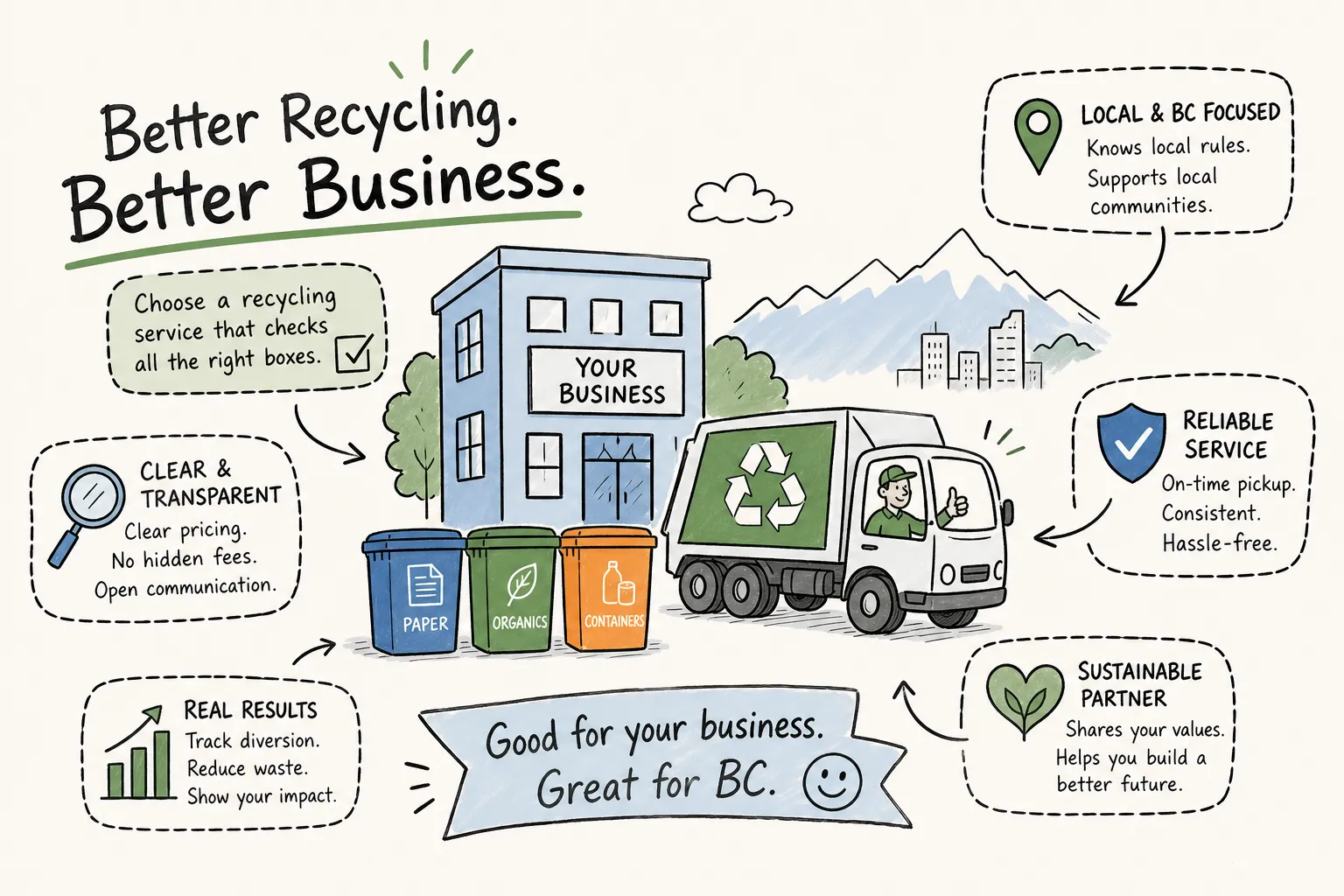
If you’re wondering what to look for when choosing a business recycling service in Metro Vancouver, the answer isn’t whoever is closest and cheapest. That’s how businesses end up locked into bad contracts, drowning in bogus fees, and getting zero data on whether any of it is actually working. Many BC businesses prioritize proximity and price when selecting a hauler, and most regret it.
There’s a better model out there, one built around flexible terms and real accountability, with pricing you can actually see. But before you request any quotes, you need to know what you’re evaluating. These six criteria are what separates a dependable commercial recycling service in BC from one that costs you more than it saves.
This is the criterion most businesses skip, and it’s the one that bites them hardest. BC businesses operate under both provincial Extended Producer Responsibility rules and local municipal bylaws, and the two don’t always line up neatly.
Under BC’s Recycling Regulation, businesses that supply packaging and paper products to BC residents are obligated to join Recycle BC or another approved stewardship plan. What most business owners don’t realize is that Recycle BC’s depot program is designed for residential material only. Industrial, commercial, and institutional waste doesn’t go through those channels. Your hauler needs to understand which streams fall under stewardship programs and which require separate commercial handling. If they’re vague on the distinction, that’s a problem. Small businesses generating under one tonne of packaging annually or with under $1 million in revenue may qualify for exemptions from some reporting requirements, so it’s worth checking your eligibility.
For businesses in Metro Vancouver specifically, the Organics Disposal Ban is non-negotiable. Loads containing 25% or more food waste by weight are subject to a 50% surcharge on the tipping fee at regional facilities, and that surcharge typically gets passed back to you. A hauler that doesn’t offer organics pickup or doesn’t understand the ban isn’t a viable option in this region. Treat organics compliance as a filter: if a provider can’t handle it, move on.
Not every commercial recycler accepts every stream. This matters because you want a single vendor relationship, not five different pickup schedules with five separate invoices.
A full-service provider should cover the core commercial streams: mixed containers (glass, metals, and plastics), paper and cardboard, and organics or food waste. Full-stream coverage under one provider simplifies compliance reporting, reduces vendor management headaches, and makes monthly diversion tracking straightforward. Ask specifically how they handle source-separated materials. A provider that co-mingles streams at the point of pickup is compromising recyclability and likely creating downstream processing problems.
Specialty materials are where things get complicated. Styrofoam (EPS foam) and electronics are streams that some large haulers don’t accept, leaving businesses scrambling for a second vendor. These streams are not universally accepted, so confirm with providers before signing anything. If your operation generates either of these, get that acceptance confirmed in writing. Verbal assurances aren’t worth much when a driver shows up and refuses to load a bin full of foam packaging.
These two criteria belong together because one almost always hides the other. Opaque pricing gets buried in long-term contracts, and that combination is where businesses consistently get burned.
Commercial recycling services in BC typically use one of three pricing models: per pickup or per bin, per tonne, or fixed-term service contracts. Per-tonne pricing in BC ranges widely, from around $179 to over $2,600 depending on container type, material, and handling method. Front-end bins, roll-off bins, and compactor services all carry different cost structures. The quoted rate is rarely the full story, minimum charges, fuel surcharges, and contamination fees can inflate a competitive-looking quote significantly. For smaller businesses, a practical monthly benchmark in Metro Vancouver runs $50 to $200 per container depending on volume and pickup frequency.
Month-to-month service agreements reduce the risk of long-term lock-in during service failures, route changes, or restructuring. Ask about auto-renewal clauses and cancellation terms before signing. Providers who require 12-month minimums to retain customers are telling you something about their service confidence. Ask directly whether pricing is fixed or subject to unilateral increases, and get the answers in writing.
This is where the day-to-day experience of working with a recycling provider shows up. It’s also where a lot of providers cut corners because most businesses don’t ask the right questions upfront.
Bins that aren’t cleaned between pickups attract pests, create odor problems, and become a genuine health and safety issue for food-service businesses dealing with organics waste. Demand a regular bin-cleaning schedule or an agreed sanitation rotation, practices vary by provider and material stream, so get the specifics in writing. Unsanitary bins are a liability, not just an inconvenience. If you’re in the food industry and subject to health inspections, that distinction matters.
Pickup frequency needs to match your actual waste volume, not a provider’s preferred routing schedule. A full-service commercial recycler should be able to accommodate daily, weekly, bi-weekly, or on-demand pickups depending on your operation. Restaurants and high-volume retail locations generate organics quickly, and a weekly schedule designed for an office building won’t work for a commercial kitchen. A provider who won’t customize pickup timing to your business is running a one-size-fits-all operation, and you’ll feel that mismatch every week.
These two criteria tell you whether a provider is actually accountable for results or just picking up bins and moving on.
A meaningful monthly diversion report should include total waste generated, total weight diverted by material stream, diversion rate as a percentage, contamination rate, and trend data over time. Some providers also include per-employee generation rates, which is useful if you’re tracking sustainability goals across locations or reporting to stakeholders. Diversion reporting supports ESG commitments, helps satisfy municipal compliance documentation requirements, and gives you actual evidence that your recycling program is working. Not all Metro Vancouver haulers offer this as a standard feature, so treat it as a meaningful point of comparison when evaluating providers.
On credentials, the non-negotiable baseline is valid BC operating permits, WorkSafeBC coverage, and general liability insurance. For specific streams, ask about relevant certifications: R2 certification for electronics recyclers, ISO 14001 for environmental management systems, and Recycle BC collector qualification for packaging streams. Don’t rely on verbal confirmation. Request documentation before signing any service agreement. If a provider hesitates to supply permit, insurance, or certification documentation on request, treat that as a red flag.
You don’t need to test every hauler in the Lower Mainland. You just need to ask better questions than most businesses bother with, the kind that expose contract traps and service gaps before you’re locked in. Here’s where to start:
A provider who struggles to answer these clearly is telling you something. These aren’t difficult questions for a well-run operation. Get at least two or three quotes with written scope of service before making a decision. That’s the minimum due diligence, and it takes less time than untangling a bad contract later.
The profile of a solid full-service provider in Metro Vancouver looks like this: handles organics, mixed containers, paper, Styrofoam, and e-waste under one relationship; offers month-to-month terms; delivers clean bins; and sends monthly diversion reports. EcoAction Recycling is structured around this model, serving businesses across Vancouver, Burnaby, Surrey, Coquitlam, and surrounding Lower Mainland communities. If your current provider doesn’t meet these criteria, you’re leaving value on the table, and switching is simpler than most businesses assume.
Knowing what to look for when choosing a business recycling service in BC comes down to six things: compliance fit, material coverage, transparent pricing, flexible contract terms, clean bins, and real diversion reporting. Those criteria separate a solid long-term partner from a service you’ll regret signing.
The right providers make these questions easy to answer. If a hauler hedges on contract terms or can’t tell you what’s in their diversion report, keep looking. Ask the right questions, get the answers in writing, and if a hauler can’t deliver on both, move on.
EcoAction Recycling offers straightforward commercial recycling quotes with no commitment required. Reach out to our team to see what a transparent service agreement actually looks like.